Philipp Mayr Visits WING: AI Overload and Scholarly Document Processing

We were delighted to host Philipp Mayr (GESIS - Leibniz Institute for the Social Sciences) at our group meeting on February 20, 2026. He introduced the Knowledge Technologies department, the Information and Data Retrieval team, the OMINO project, and two Scholarly Document Processing projects.
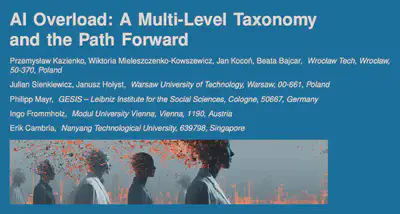
One highlight was the recent paper “AI Overload: A Multi-Level Taxonomy and the Path Forward” (IEEE Intelligent Systems, 2026), which defines AI overload as a sustained mismatch between AI-amplified demands and human or institutional capacity for supervision and validation.
The talk discussed AI overload across individuals (cognitive strain), organizations (coordination burden), and societies (polarization), and examined overload patterns such as cognitive, informational, coordination, monitoring/control, normative, and affective burdens.
A key insight was that in modern AI systems, the bottleneck is no longer generation, but oversight. As AI autonomy grows, validation, monitoring, and accountability demands increase. Mitigation therefore requires bounded autonomy, calibrated reliance, governance mechanisms, and stronger AI literacy.
Paper: AI Overload: A Multi-Level Taxonomy and the Path Forward
We thank Philipp for the inspiring and thought-provoking talk!
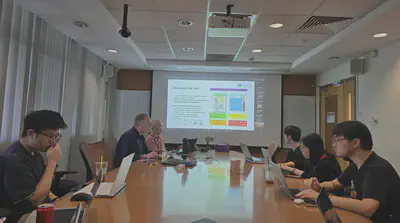
Below is a gallery of the seminar, photo credit to Sahaj!


Min-Yen Kan
Associate Professor
WING lead; interests include Digital Libraries, Information Retrieval and Natural Language Processing.